Product
 Brand
Brand Articles
 Tools
Tools
Automotive vs. Industrial Memory: How to Verify Grade Codes Before Sourcing In this guide
In this guide
Memory ordering codes can look almost identical while representing different temperature limits, packages, revisions, qualification evidence, or lifecycle commitments. For automotive and long-life industrial designs, the safe purchasing unit is the complete manufacturer ordering code, not a base part number plus a familiar-looking suffix.
Quick answer
Use three separate checks:
Identity: Match every character in the full ordering code to the exact product-family datasheet or live manufacturer catalog.
Operating limits: Confirm the specified temperature variable and range, such as case temperature or ambient temperature. Do not silently treat them as interchangeable.
Qualification and supply controls: Confirm the manufacturer's automotive designation, applicable AEC-Q100 statement or qualification evidence, traceability, PCN/EOL terms, and any customer-required PPAP submission.
Parts are not interchangeable merely because one has a wider temperature range. Any proposed substitution needs a documented comparison and approval by the responsible engineering and quality teams. Automotive programs may also require customer approval before a changed part, process, or source is used.
1. Start with the complete ordering code
An ordering code is a sequence of fields, but the field boundaries and meanings are defined by the manufacturer for a particular product family. A useful workflow is:
Copy the full code from the purchase record, reel label, or approved bill of materials.
Find the exact code in the current manufacturer catalog.
Open the matching family datasheet and ordering-information table.
Record density and organization, package, speed, voltage, temperature option, revision or special option, lifecycle status, and qualification statement.
Treat blanks, spaces, colons, and trailing revision characters as meaningful until the manufacturer documentation proves otherwise.
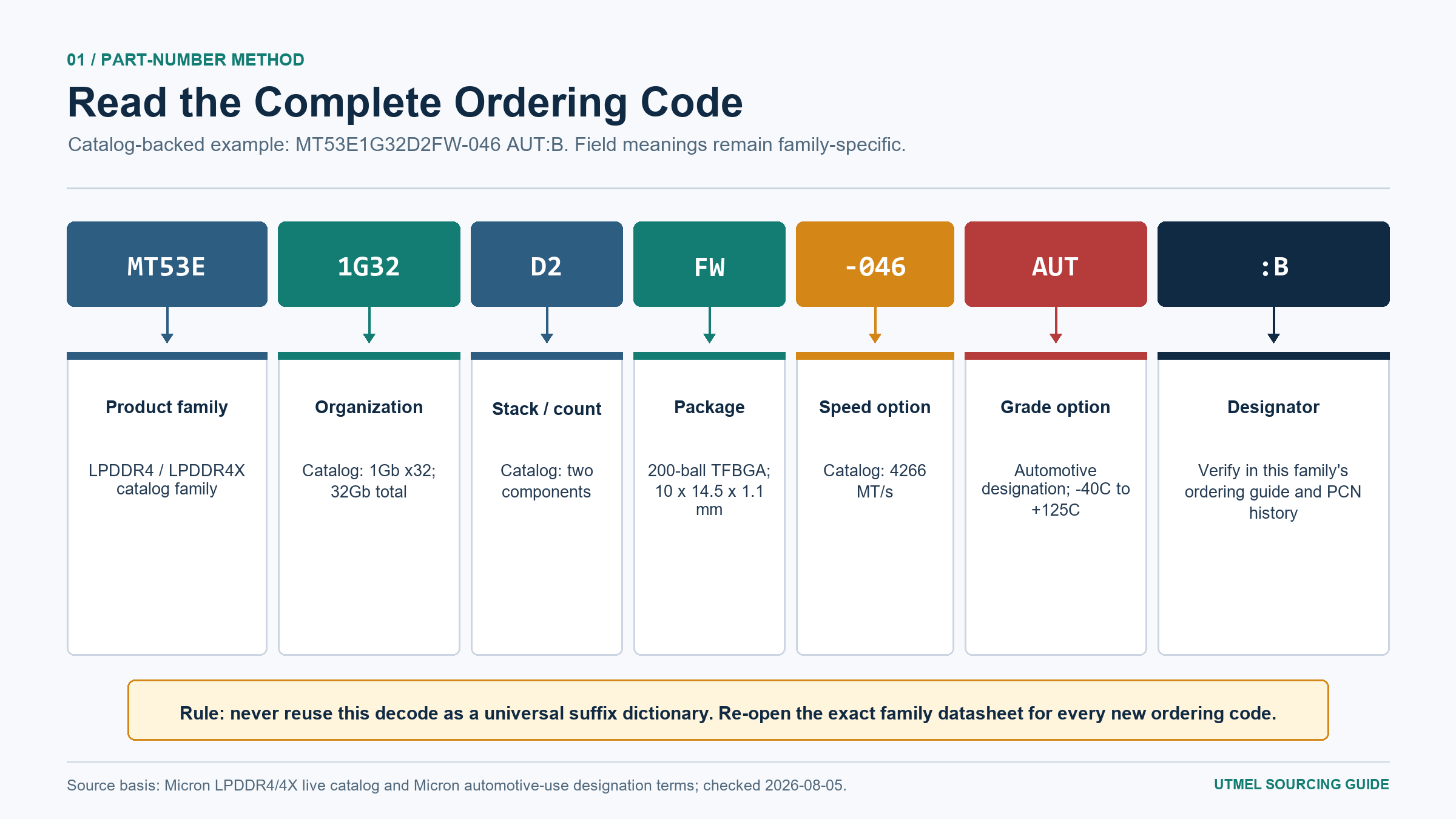
The diagram uses MT53E1G32D2FW-046 AUT:B as a catalog-backed example. It is a method illustration, not a universal Micron decoder. A field that means one thing in an LPDDR4/4X family may not carry the same meaning in DDR4, NAND, NOR, or a later product generation.
2. Read the grade in the context of the product family
Micron's terms state that products are not intended for automotive applications unless Micron designates them as automotive grade with an A*T suffix, including AIT, AAT, and AUT, or designates them in the applicable datasheet. This supports a practical rule: the automotive designation belongs to the complete documented ordering code.
It does not support a universal suffix table for all memory families. To decode the rest of the suffix safely, use the exact family datasheet and live catalog row. Even when two parts share AUT, they can differ in memory technology, organization, package, speed, revision, thermal behavior, test coverage, and lifecycle status.
An industrial-temperature IT code is not the same claim as Micron's automotive AIT designation. Similar temperature numbers do not erase the difference in product designation or supporting qualification package.
3. Temperature range and AEC-Q100 are different checks
AEC-Q100 Rev. J1 defines four part operating temperature grades:
| AEC-Q100 grade | Ambient operating temperature range |
|---|---|
| Grade 0 | -40C to +150C |
| Grade 1 | -40C to +125C |
| Grade 2 | -40C to +105C |
| Grade 3 | -40C to +85C |
The temperature table is only one part of the standard. AEC-Q100 also defines qualification and requalification requirements, stress-test methods, sample requirements, failure criteria, and user approval concepts. A component whose catalog range happens to match Grade 1 is not proven AEC-Q100 qualified by that numerical match alone.
Also check which temperature the memory datasheet controls. A DRAM datasheet may specify case temperature, while AEC-Q100's grade table is expressed as ambient operating temperature. The system's thermal model must connect the application conditions to the limit stated in the component documentation.
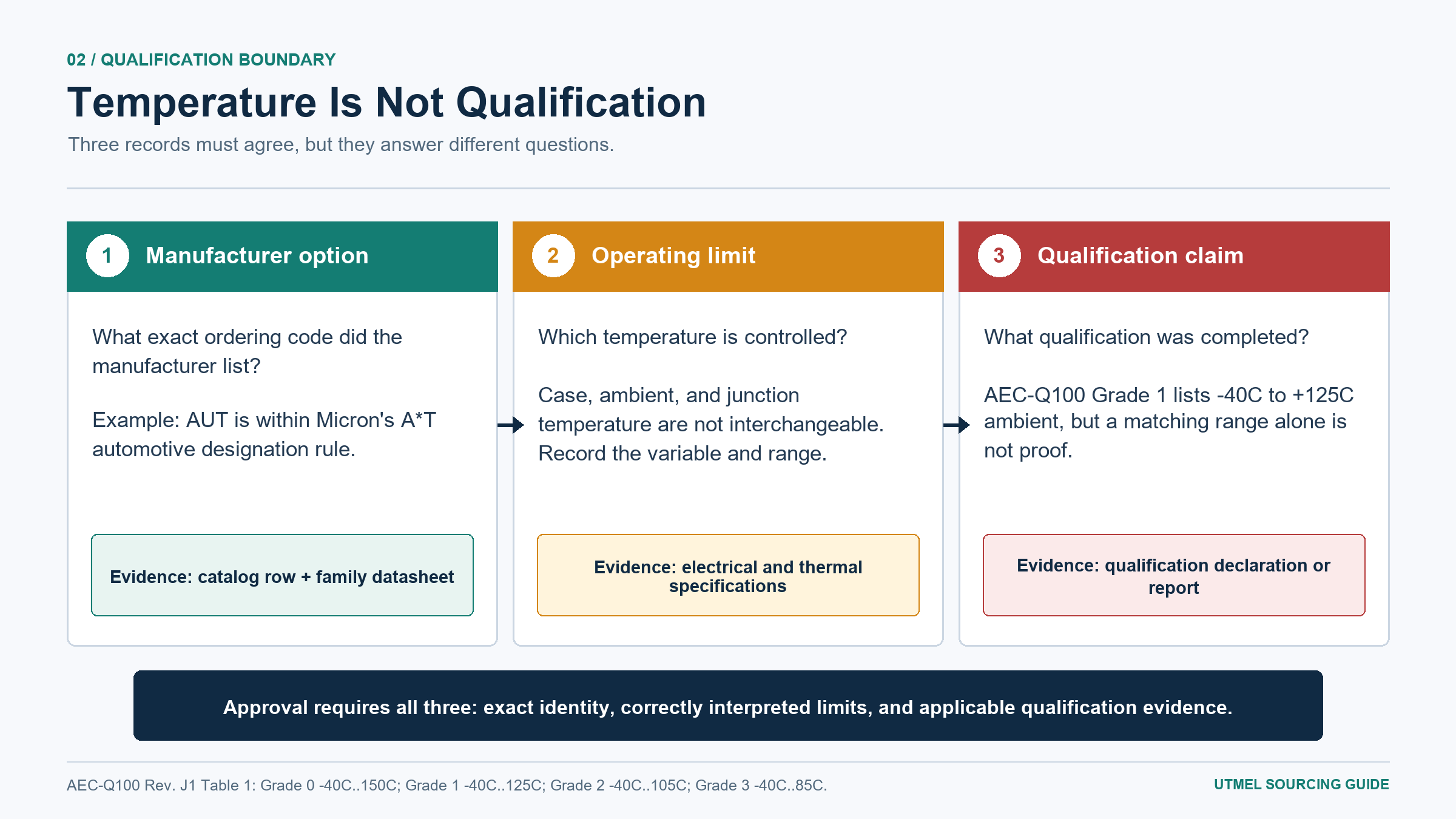
For sourcing records, write these as separate fields:
Manufacturer temperature option and stated range
Controlled temperature variable: ambient, case, or junction
Automotive designation in the ordering code or datasheet
AEC-Q100 revision and grade claimed by the supplier
Qualification report or declaration reviewed
Customer-specific mission profile and approval status
4. Two catalog examples show why the full code matters
The following values were checked in Micron's live catalogs on August 5, 2026. Product status and availability can change, so recheck them when placing an order.
| Full ordering code | Catalog identity | Operating range | Qualification interpretation |
|---|---|---|---|
MT53E1G32D2FW-046 AUT:B | 32Gb LPDDR4, 1Gb x32, two components, 4266 MT/s, 1.1/0.6V, x32, 200-ball TFBGA, 10.00 x 14.50 x 1.10 mm | -40C to +125C | AUT falls within Micron's A*T automotive designation rule. Confirm the family datasheet and program-specific qualification package. |
MT40A1G16TB-062E IT:F | 16Gb DDR4, 1Gb x16, 3200 MT/s, 1.2V, CL22, x16, 96-ball TFBGA, 7.50 x 13.00 x 1.20 mm | -40C to +95C | IT is an industrial-temperature ordering code, not Micron's A*T automotive designation. Do not infer automotive qualification from temperature coverage. |
These parts are not interchangeable; they use different technologies and interfaces. They are shown together only to demonstrate how much information sits behind a complete ordering code.
5. Do not approve a substitution from the suffix alone
A proposed change from AAT to AUT, IT to AIT, one package code to another, or one trailing revision to another is an engineering change, not a text-editing exercise. A wider maximum temperature is only one comparison point.
Before approving any replacement, compare:
| Check | What must match or be accepted |
|---|---|
| Technology and organization | DDR/LPDDR generation, density, width, channel and die organization |
| Package and assembly | Ball map, dimensions, height, pitch, substrate option, solder and MSL requirements |
| Electrical limits | Supply rails, I/O levels, timing, speed bin, refresh behavior, power states and initialization |
| Thermal basis | Specified temperature variable, operating range, self-heating assumptions and system margin |
| Qualification | Automotive designation, AEC-Q100 evidence, grade, family applicability and report scope |
| Revision and change control | Datasheet revision, silicon/package revision, PCN impact and requalification needs |
| Supply evidence | Manufacturer, authorized source status, lot/date code, country of origin where required, chain of custody |
| Program approval | AVL/BOM status, validation results, quality approval and customer-specific approval |
Substitution warning: do not release a different suffix or revision to production until the responsible engineering and quality owners have approved the exact ordering code and the required customer process has been completed.
6. Request an evidence package, not just a quotation
The required documents depend on the program and customer, but a controlled request can include:
Manufacturer datasheet and exact ordering-information page
Current manufacturer catalog record and lifecycle status
Automotive qualification declaration or report identifying the applicable family, AEC-Q100 revision, and grade
PPAP submission elements required by the customer, when PPAP applies
PCN/EOL notification terms and the contact or account through which notices will be delivered
Certificate of conformance and traceability fields for the offered lot
Packaging, moisture sensitivity, shipping, storage, and handling requirements
Record of approved source, incoming inspection plan, and deviation approval if the code differs from the BOM
AIAG describes PPAP as a process for showing that engineering design records and specification requirements can be met consistently in production. That does not mean every distributor quote includes a PPAP package. The buyer should define the required submission level and confirm who is responsible for obtaining and reviewing it.
Micron's CSN-12 explains that its PCN/EOL system covers changes affecting form, fit, function, quality, or reliability, as well as planned discontinuation. Notification access and timing should be established before production, not reconstructed after a change notice is missed.
7. Build provenance and incoming inspection into acceptance
Start by checking the manufacturer or its current authorized-distributor list. Then verify that the seller, invoice, certificate, packing labels, reels or trays, and device markings form a consistent chain of custody for the offered lot.
Incoming inspection may include label reconciliation, quantity and packaging checks, visual inspection, dimensional checks, marking comparison, solderability or electrical sampling, and advanced analysis when risk warrants it. These activities can reveal anomalies. They do not, individually or together, recreate missing manufacturer qualification evidence or prove that an unauthorized chain is equivalent to an authorized one.
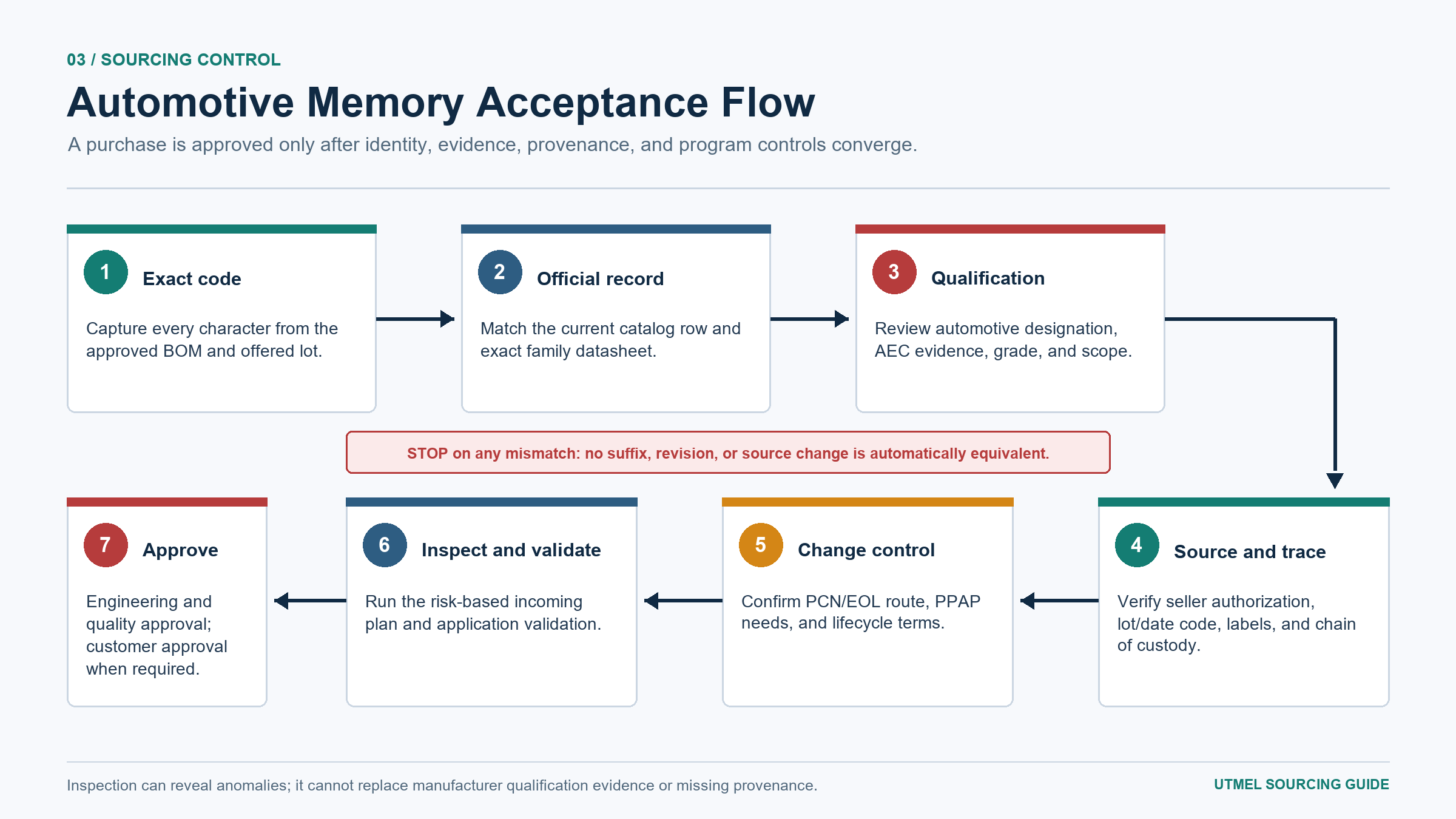
For long-life programs, also confirm the actual lifecycle program. Automotive or industrial temperature does not by itself promise a particular number of supply years. Micron, for example, separates standard lifecycle support from selected Product Longevity Program offerings.
8. A practical approval record
A concise approval record should let another engineer reconstruct the decision later. Capture:
Approved full ordering code and manufacturer
Datasheet and catalog revision/date reviewed
Package, speed, voltage, organization, and temperature basis
Automotive designation and qualification evidence reviewed
Source, lot/date code, and traceability documents
PCN/EOL enrollment or contractual notification route
Validation performed and results
Deviations, risk acceptance, engineering sign-off, quality sign-off, and customer approval
This record is more durable than a note saying “automotive grade” or “same specifications.” It documents what was actually compared and who accepted the remaining risk.
FAQ
What does AUT mean in a Micron memory ordering code?
Micron identifies AUT as one of the A*T suffix patterns used for automotive-grade designation, unless automotive use is instead designated by the applicable datasheet. The detailed temperature and option meaning must still be read from the exact product-family documentation.
Is an IT part the same as an AIT part?
No. IT identifies an industrial-temperature option in the relevant Micron family, while AIT falls within Micron's A*T automotive designation rule. Similar operating ranges do not make the qualification claims or documentation identical.
Does -40C to +125C automatically mean AEC-Q100 Grade 1?
No. That range matches the ambient range shown for Grade 1 in AEC-Q100 Rev. J1, but a numerical match does not prove that the device completed the applicable qualification flow. Confirm the supplier's qualification evidence and the temperature variable specified by the component datasheet.
Can an AUT part replace an AAT part?
No. AUT and AAT parts are not interchangeable based on the suffix alone. Compare the exact package, ball map, electrical limits, timing, speed, revision, thermal requirements, qualification scope, traceability, PCN impact, and customer requirements. Release the change only after engineering and quality approval, plus customer approval when required.
What does the character after the colon mean?
It is a manufacturer-controlled designator whose meaning can depend on the product family and documentation revision. Do not assume it always identifies the same type of silicon or package revision. Use the exact ordering guide, datasheet, and PCN history.
Can X-ray or functional testing prove that stock is automotive qualified?
No. Inspection and testing can identify anomalies and show how sampled units behaved under defined conditions. They do not substitute for manufacturer designation, qualification records, traceability, and the required program approvals.
Official references
Micron DDR4 SDRAM part catalog
Related Utmel resources
 UTMEL
UTMEL
We are the professional distributor of electronic components, providing a large variety of products to save you a lot of time, effort, and cost with our efficient self-customized service. careful order preparation fast delivery service
 High-Capacity HDDs in the AI Era: Sourcing Massive Storage for Cold DataUTMEL04 July 2026501
As generative AI and LLMs drive an explosion of unstructured data, high-capacity enterprise HDDs remain the most cost-effective solution for cold storage. Despite rising prices and supply chain bottlenecks, mechanical drives offer a massive cost-per-gigabyte advantage over SSDs. Technologies like HAMR and SMR enable capacities beyond 24TB, though deploying these drives requires robust RAID 6 strategies and secured IC supply chains to mitigate rebuilding and procurement risks.
Read More LPDDR5 Memory 2026: Lead Times, HBM Impact, and Procurement StrategiesUTMEL17 July 20263160
Global semiconductor fabrication facility managing advanced memory production. In Q2 2026, contract prices for 12GB LPDDR5X modules surged 89% quarter-over-quarter, jumping from $77.10 to $145.90, while lead times for advanced memory components stretched to 40–58 weeks. A vehicle platform designed in 2023 with specific memory requirements must ship in 2026, regardless of spot market conditions.
Read More 2026 DRAM and the 3-to-1 HBM Rule: Market Supply Analysis and B2B Procurement GuideUTMEL23 July 20262438
This technical report explains how the physical "3-to-1 wafer penalty" of High Bandwidth Memory (HBM) production has cannibalized standard DRAM capacity, causing severe shortages of DDR4 and DDR5 in 2026. As major hardware OEMs pass these soaring component costs directly to enterprise buyers, procurement teams must abandon Just-in-Time models in favor of rolling safety stocks and strategic long-term distributor agreements to protect budgets.
Read More Automotive vs. Industrial Memory: How to Verify Grade Codes Before Sourcing In this guideUTMEL06 August 2026278
Memory ordering codes can look almost identical while representing different temperature limits, packages, revisions, qualification evidence, or lifecycle commitments. For automotive and long-life industrial designs, the safe purchasing unit is the complete manufacturer ordering code, not a base part number plus a familiar-looking suffix.
Read More How to Use an External Hard Drive?UTMEL24 June 20219330
The external hard drive is a compact and portable hard drive storage which can be plugged in or unplugged at any time. It mainly uses USB or IEEE1394 interfaces. It can transmit data with the system at a higher speed. The IEEE 1394 interface transfer rate is 50-100 MB/s.
Read More
Subscribe to Utmel !